 Jul 04, 2026 - 0
Minutes read
Jul 04, 2026 - 0
Minutes read
NVIDIA RTX Spark: The Future of AI Computing
NVIDIA RTX Spark Shapes the Future of AI Computing: What It Means for Users and Businesses
NVIDIA RTX Spark Shapes the Future of AI Computing: What It Means for Users and Businesses
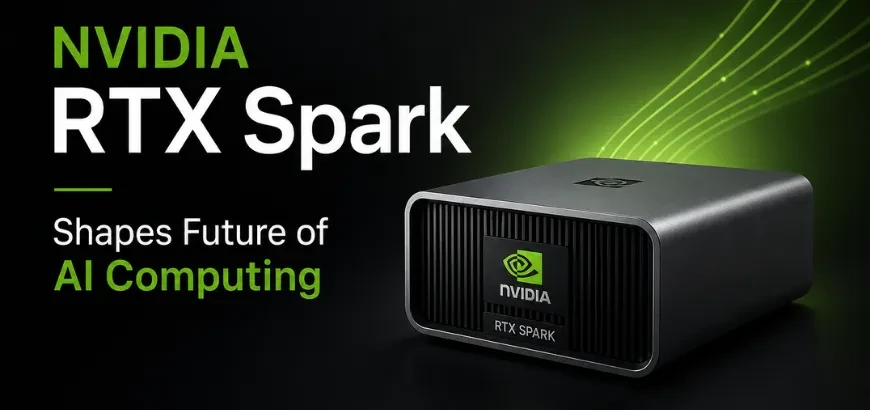
NVIDIA RTX Spark is a compact, high-performance AI computing platform powered by NVIDIA's RTX GPU architecture. Built for edge AI, content creation, and enterprise workloads, RTX Spark brings data center-grade AI acceleration to desktops and small form-factor devices—making advanced AI more accessible for developers, businesses, and creators.
AI is advancing faster than most people expected—and keeping up with the hardware behind it can feel overwhelming. For developers, businesses, and everyday users trying to future-proof their workflows, choosing the right AI computing platform is no small decision.
That's where NVIDIA RTX Spark enters the picture. This post breaks down exactly what NVIDIA RTX Spark is, how it works, which industries stand to benefit most, and why it could be one of the most significant developments in AI computing this decade. No jargon, no hype—just clear, useful information.
Why Does NVIDIA RTX Matter in the Future of AI Computing?
The rise of generative AI, large language models (LLMs), and real-time AI inference has created enormous demand for raw computing power. Historically, that power lived exclusively in data centers. Sending data to the cloud, waiting for a response, and managing latency was the norm—and for many enterprise applications, it still is.
NVIDIA RTX changes that dynamic. By embedding powerful GPU acceleration, Tensor Cores, and dedicated AI processing directly into consumer and edge-class hardware, NVIDIA RTX enables what the industry calls local AI inference—running AI models directly on the device, without relying on cloud connectivity.
NVIDIA RTX Spark pushes this even further. Designed as a compact, energy-efficient AI computing module, RTX Spark targets a growing segment of users who need serious AI performance in a small, deployable footprint. That includes enterprise edge deployments, creative professionals, AI researchers, and software developers building the next generation of intelligent applications.
The broader significance? As AI workloads continue to move closer to the end user—a shift often called "AI at the edge"—hardware platforms like NVIDIA RTX Spark are likely to become foundational infrastructure, not optional upgrades.
How Does NVIDIA RTX Spark Shape AI Computing Step-by-Step?
Understanding NVIDIA RTX Spark's role in the AI pipeline requires a quick look at how AI computing actually works—and where bottlenecks tend to appear.
Key Technologies Behind NVIDIA RTX: GPUs, Tensor Cores, AI Acceleration, and Real-Time Processing
Several core technologies combine to make NVIDIA RTX Spark a capable AI computing platform. Here's what matters most.
What Role Do NVIDIA RTX GPUs Play in AI Workloads?
Graphics Processing Units (GPUs) were originally built to render complex visuals in real time. That same capability—executing thousands of parallel computations simultaneously—turns out to be exactly what AI model training and inference requires. NVIDIA RTX GPUs are purpose-engineered for this dual role, supporting both visual rendering and deep learning workloads on the same silicon.
How Do Tensor Cores Accelerate AI Performance?
Tensor Cores are specialized processing units embedded within NVIDIA RTX GPUs. They perform matrix multiplication—the mathematical backbone of neural network operations—at significantly higher throughput than standard CUDA cores. NVIDIA's fourth-generation Tensor Cores support FP8 precision, allowing models to run faster and more efficiently while maintaining output quality.
What Is NVIDIA DLSS and How Does It Connect to AI?
NVIDIA Deep Learning Super Sampling (DLSS) is an AI-powered image upscaling technology that uses neural networks to generate high-resolution frames from lower-resolution inputs. While primarily known in gaming, DLSS represents a practical, real-world demonstration of RTX AI capabilities—and the same underlying technology transfers directly to professional visualization and simulation workloads.
How Does NVIDIA RTX Spark Handle Real-Time AI Processing?
NVIDIA RTX Spark combines RTX GPU architecture with optimized software libraries—including CUDA, cuDNN, and TensorRT—to minimize inference latency. TensorRT, in particular, compiles and optimizes trained AI models for specific RTX hardware, squeezing out additional performance gains that generic compute platforms cannot match.
How Is NVIDIA RTX Changing Different Industries?
The impact of NVIDIA RTX Spark extends well beyond a single sector. Here are the industries experiencing the most significant transformation.
Healthcare and Medical Imaging
AI-powered diagnostic tools rely on fast, accurate analysis of high-resolution medical images. NVIDIA RTX Spark enables hospitals and clinics to run imaging AI models locally—keeping patient data on-premises for compliance purposes while delivering rapid diagnostic assistance that supports (not replaces) clinical judgment.
Film, Animation, and Creative Production
Real-time ray tracing and AI-powered denoising have fundamentally changed visual effects pipelines. Studios using NVIDIA RTX hardware can render photorealistic lighting and reflections in real time, accelerating production timelines and reducing rendering costs. NVIDIA RTX Spark brings this capability to smaller studios and independent creators who previously couldn't afford data center-grade rendering infrastructure.
Autonomous Systems and Robotics
Autonomous vehicles, drones, and industrial robots require split-second AI inference—there's no time to query a remote server when a sensor detects an obstacle. NVIDIA RTX Spark's edge computing architecture processes sensor data and runs navigation AI locally, making autonomous systems faster and more reliable.
Enterprise Software and Business Intelligence
Businesses are increasingly embedding AI into internal tools—customer service platforms, document analysis systems, fraud detection engines. NVIDIA RTX Spark enables these workloads to run efficiently on-premises, reducing cloud infrastructure costs and keeping sensitive business data within organizational control.
Education and Research
Universities and research institutions working on AI models often face compute constraints. NVIDIA RTX Spark offers a cost-effective entry point into serious AI research hardware, giving researchers access to professional-grade AI acceleration without the overhead of full data center deployment.
What Are the Benefits of NVIDIA RTX for AI Developers, Creators, Gamers, and Businesses?
Different user groups interact with NVIDIA RTX Spark differently—but the core benefits translate across all of them.
NVIDIA RTX Spark: A Platform Built for What Comes Next
AI computing isn't slowing down—and neither is NVIDIA's investment in RTX technology. NVIDIA RTX Spark represents a deliberate architectural choice: bring serious AI acceleration closer to where data is generated and decisions are made, rather than routing everything through centralized cloud infrastructure.
For users and businesses evaluating their AI computing strategy, RTX Spark offers a compelling combination of performance, efficiency, and flexibility. The shift toward edge AI inference is already underway. Platforms like NVIDIA RTX Spark suggest that the hardware to support it is ready.
The next step depends on your specific use case. Developers can explore NVIDIA's RTX-compatible AI software stack through the NVIDIA Developer Program. Businesses assessing edge AI deployments can evaluate RTX Spark as a foundation for local inference infrastructure. Creators and researchers can identify which NVIDIA RTX-powered tools align with their existing workflows.
Whatever direction AI computing takes next, NVIDIA RTX Spark is built to handle it.
Frequently Asked Questions
What is NVIDIA RTX in AI computing?
NVIDIA RTX refers to NVIDIA's line of GPU architectures that combine traditional graphics processing with dedicated AI acceleration hardware, including Tensor Cores. In AI computing, RTX GPUs serve as high-performance inference and training platforms, capable of running complex neural network models locally without relying on cloud infrastructure. This makes them valuable for applications where speed, privacy, or connectivity constraints make cloud-based AI impractical.
How does NVIDIA RTX help improve AI performance?
NVIDIA RTX improves AI performance primarily through Tensor Cores and the TensorRT optimization library. Tensor Cores perform the matrix multiplication operations central to neural network inference at much higher throughput than general-purpose CPU or GPU cores. TensorRT then compiles trained AI models into hardware-optimized formats, reducing latency and increasing inference speed on specific RTX hardware configurations. The practical result is faster AI outputs with lower power consumption.
Why is NVIDIA RTX important for the future of AI?
NVIDIA RTX is important for the future of AI because it enables capable AI inference at the edge—closer to where data is collected and decisions must be made. As AI applications demand real-time responses and stricter data privacy, local AI processing becomes essential. NVIDIA RTX hardware provides the performance needed to run sophisticated AI models outside of data centers, which expands where and how AI can be practically deployed.
Is NVIDIA RTX only useful for gaming?
No—NVIDIA RTX serves a broad range of professional and enterprise applications beyond gaming. While NVIDIA RTX became widely known through gaming features like DLSS and real-time ray tracing, the same GPU architecture powers AI research, medical imaging, autonomous systems, creative production pipelines, and enterprise AI workloads. Gaming remains an important use case, but professional and enterprise applications now represent a significant and growing share of RTX adoption.
How can businesses benefit from NVIDIA RTX AI computing?
Businesses benefit from NVIDIA RTX AI computing primarily through reduced cloud costs, improved data privacy, and faster AI-powered decision-making. Running AI inference locally on RTX hardware eliminates per-query cloud processing fees and keeps sensitive data within organizational control—particularly important in regulated industries like healthcare and finance. For businesses deploying real-time AI applications, the latency reduction from local processing can directly improve customer experience and operational efficiency.