 Jul 04, 2026 - 0
Minutes read
Jul 04, 2026 - 0
Minutes read
TV Technology Explained: How to Choose the Right TV for Your Home
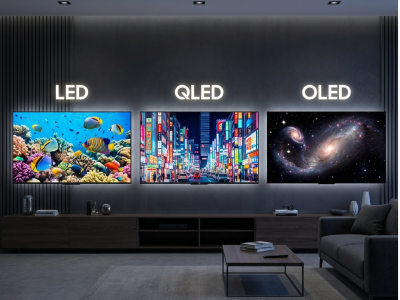
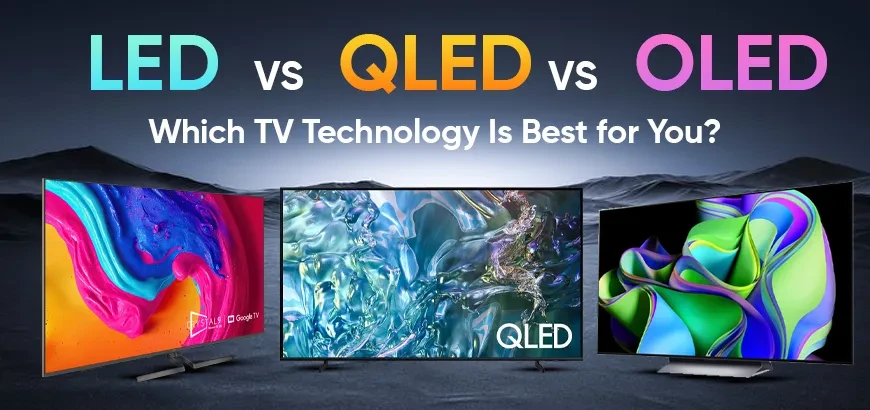
LED vs QLED vs OLED: Which TV Technology Is Best for You
The best TV for your home depends on your budget, room lighting, and how you use it. OLED offers the deepest blacks and best contrast, QLED excels in bright rooms, and Mini-LED bridges the gap between the two. Understanding these differences before you buy saves money and prevents regret.
Buying a new TV feels simple—until you're standing in a store surrounded by a wall of screens, all looking incredible, with price tags that range from "reasonable" to "why does this cost more than my car?" The alphabet soup of acronyms (OLED, QLED, Mini-LED, HDR, 4K) can make even a confident shopper freeze up. And making the wrong choice means living with a picture that disappoints you every single night.
This guide cuts through the confusion. By the end, you'll know exactly what each TV technology does, who it's best suited for, and how to match the right display to your room, budget, and viewing habits—without needing an engineering degree to do it.
Why Understanding TV Technology Is Important
Most people spend more time researching a $50 purchase on Amazon than they do a $1,500 television. That gap matters. TV technology has changed dramatically over the last decade, and a screen that looks stunning in a brightly lit showroom may look washed out in your living room at night.
Beyond picture quality, TV technology now affects gaming responsiveness, energy consumption, lifespan, and even how well your TV integrates with smart home systems. Knowing what's under the hood helps you avoid paying a premium for features you'll never use—or worse, skimping on the one thing that would have made all the difference.
What Are the Different Types of TV Technology?
Before comparing brands, it helps to understand the core display technologies powering modern televisions. Each works differently at a fundamental level, and those differences show up clearly on screen.
How Does LED TV Technology Work?
LED TVs are the most common type on the market. They use a liquid crystal display (LCD) panel backlit by light-emitting diodes (LEDs). The LEDs sit either behind the full panel (full-array) or along the edges (edge-lit). Full-array LED TVs offer better local dimming—the ability to dim specific zones independently—which improves contrast compared to edge-lit models.
LED technology is affordable, widely available, and energy-efficient. The trade-off is that LCD panels can't block light completely, which limits how dark blacks can get.
How Does OLED TV Technology Work?
OLED (Organic Light-Emitting Diode) panels work differently from LED. Each individual pixel generates its own light and can turn off completely. This produces true blacks, infinite contrast ratios, and exceptionally vibrant colors.
Because each pixel is self-emissive, OLED screens are also remarkably thin. Sony, LG, and Panasonic have all built flagship OLED televisions. The main limitation is brightness—OLEDs can struggle in very bright rooms—and a potential for image retention (sometimes called burn-in) if static images are displayed for extended periods.
How Does QLED TV Technology Work?
QLED (Quantum Light-Emitting Diode) is Samsung's proprietary technology, also used by TCL and Hisense. It layers quantum dot film over a traditional LED/LCD panel. The quantum dots enhance color volume and peak brightness, making QLED TVs particularly strong performers in well-lit rooms.
QLED televisions typically reach higher peak brightness than OLEDs, which is a meaningful advantage for HDR content in sunlit living rooms. They don't match OLED's black levels, but the gap has narrowed significantly with newer models.
How Does Mini-LED TV Technology Work?
Mini-LED is an evolution of full-array LED. The backlighting uses thousands of much smaller LEDs organized into hundreds of dimming zones. More zones mean more precise local dimming, better contrast, and reduced blooming (the halo effect around bright objects on dark backgrounds).
Samsung's Neo QLED range and Apple's Pro Display XDR both use Mini-LED. For buyers who want near-OLED picture quality without the burn-in risk, Mini-LED is a compelling middle ground.
How Does MicroLED TV Technology Work?
MicroLED is the most advanced display technology currently available. Like OLED, each pixel is self-emissive. Unlike OLED, MicroLED uses inorganic materials, which means no burn-in risk, higher brightness, and a theoretically longer lifespan.
At present, MicroLED TVs are extremely expensive—Samsung's 110-inch MicroLED model launched at approximately $150,000. The technology is promising but not yet practical for most households.
Best TV Display Options: LED, OLED, QLED, Mini-LED, or MicroLED?
No single technology wins for every buyer. Here's how they stack up across the criteria that matter most.
Technology | Black Levels | Peak Brightness | Burn-In Risk | Price Range |
|---|---|---|---|---|
LED | Moderate | Moderate | None | $ |
QLED | Good | Excellent | None | $$ |
OLED | Excellent | Good | Low–Moderate | $$$ |
Mini-LED | Very Good | Excellent | None | $$–$$$ |
MicroLED | Excellent | Excellent | None | $$$$ |
Choose OLED if you watch movies in a dark room and want cinematic picture quality above everything else.
Choose QLED if your living room gets a lot of natural light and brightness is a priority.
Choose Mini-LED if you want excellent contrast and high brightness without burn-in risk, at a more accessible price than OLED.
Choose LED if you're on a tighter budget and prioritize value and reliability.
Choose MicroLED if budget is no object and you want the pinnacle of current display technology.
Key Features to Look For in Modern TV Technology
Display type is only one piece of the puzzle. These additional features can significantly affect the quality of your everyday viewing experience.
What Resolution Should Your TV Be?
4K Ultra HD (3840 x 2160 pixels) is the current standard for most TVs above 40 inches. 8K resolution exists but content remains extremely limited, and the pixel difference is barely perceptible at normal viewing distances. For most buyers, 4K is the practical sweet spot.
What Is HDR and Why Does It Matter?
High Dynamic Range (HDR) expands the range of brightness and color a TV can display. Common HDR formats include HDR10, Dolby Vision, and HDR10+. Dolby Vision is the most widely supported premium format, with dynamic metadata that optimizes picture quality scene by scene. When buying, confirm the TV supports the HDR format used by your preferred streaming services.
What Refresh Rate Do You Need?
Refresh rate measures how many frames a screen displays per second. A 60Hz panel refreshes 60 times per second; a 120Hz panel refreshes 120 times. For standard viewing, 60Hz is sufficient. For sports, action films, and gaming, 120Hz delivers noticeably smoother motion.
What Should You Look for in Smart TV Features?
Most modern TVs include built-in smart platforms—Google TV, Tizen (Samsung), and webOS (LG) are the most common. Look for a platform that supports the streaming apps you actually use, has a responsive interface, and receives regular software updates.
How to Choose the Best TV Technology for Your Needs
With so many variables, narrowing down your choice becomes much easier when you filter by real-world priorities.
What Is Your Primary Use Case?
- Movie watching in a dark room: OLED is the clear winner. The self-emissive pixels and perfect blacks create a genuinely cinematic experience.
- Sports and daytime viewing in a bright room: QLED or Mini-LED. High peak brightness keeps the picture vivid even in direct sunlight.
- Gaming: Look for a 120Hz refresh rate, low input lag (under 10ms), and HDMI 2.1 support for 4K/120fps gaming on PlayStation 5 or Xbox Series X. LG's OLED TVs consistently rank among the best gaming displays available.
- General everyday use: A mid-range QLED or full-array LED TV delivers excellent performance without the premium price.
How Big Should Your TV Be?
Screen size and viewing distance are directly related. A rough guide: multiply your intended viewing distance (in inches) by 0.84 to estimate the ideal screen size. Sitting 10 feet (120 inches) from a TV? Approximately 100 inches is the theoretical maximum, though 65–85 inches is a more practical range for most living rooms.
What Budget Should You Set?
As a general benchmark:
- Under $500: Solid LED or entry-level QLED
- $500–$1,000: Full-array LED or mid-range QLED with 120Hz
- $1,000–$2,000: Premium QLED, Mini-LED, or entry-level OLED
- $2,000+: Flagship OLED or large-screen Mini-LED
The Smartest TV Purchase Starts with the Right Information
TV technology advances quickly, but the core decision framework stays consistent: match the display technology to your room, your habits, and your budget. OLED rewards dark-room cinephiles. QLED punches through bright environments. Mini-LED splits the difference. And LED remains the dependable, affordable foundation the whole industry is built on.
Before you buy, visit a showroom if possible and ask the staff to demonstrate local dimming on a dark scene—that single test reveals more about a TV's real-world performance than any spec sheet. Check that your chosen TV supports HDMI 2.1 if you're a gamer, confirm Dolby Vision support if you stream premium content, and don't let screen size tempt you beyond what your room can comfortably accommodate.
The right TV doesn't have to be the most expensive one. It just has to be the right one for you.
Frequently Asked Questions
What is the best TV technology right now?
OLED is widely considered the best TV technology for picture quality in 2024. OLED panels produce perfect blacks, superior contrast, and wide viewing angles because each pixel generates its own light independently. For buyers who prioritize brightness over black levels—particularly in bright living rooms—Mini-LED and QLED are strong alternatives.
What is the difference between OLED and QLED TV?
OLED uses self-emissive pixels that switch off completely for true blacks, while QLED uses quantum dot-enhanced LED backlighting to achieve higher peak brightness. OLED generally performs better in dark rooms with superior contrast; QLED performs better in well-lit environments. If burn-in risk is a concern (for example, if you frequently display static images), QLED eliminates that risk entirely.
Is Mini-LED better than standard LED TV?
Yes, Mini-LED TVs deliver meaningfully better picture quality than standard full-array LED televisions. The significantly higher number of dimming zones in Mini-LED panels reduces blooming and improves local contrast. If you're choosing between a standard LED and a Mini-LED at a similar price point, the Mini-LED is almost always the better investment.
Which TV technology is best for gaming?
For gaming, OLED—particularly LG's OLED evo panels—is currently the top choice, offering near-instant response times (around 0.1ms), 120Hz refresh rates, and HDMI 2.1 support for 4K/120fps gaming. If burn-in is a concern due to long gaming sessions with static HUD elements, a Mini-LED TV with HDMI 2.1 and 120Hz is the safest high-performance alternative.
How long do modern TVs usually last?
Most modern TVs are built to last between 7 and 10 years under typical viewing conditions (approximately 4–6 hours per day). QLED and LED TVs generally have a longer functional lifespan than OLEDs because their backlighting degrades more slowly. Reducing brightness settings slightly and enabling automatic sleep timers can meaningfully extend the life of any display technology.